Overview
This lab is aimed at getting students acquainted with how psychologists attempt to measure sensation objectively.
Learning goals
- To understand the distinction between sensation and perception.
- To learn how to conduct a psychometric experiment.
- To practice using figures to visualize data.
Materials
- Note-taking materials (paper, digital)
- A space for plotting figures (whiteboard, paper)
- Paperclips
- Rulers
- Optional / nice-to-have:
- Actual callipers instead of paperclips and a ruler.
Procedure
- Hand out the callipers to groups of students if you have them, otherwise instruct students to mold the paperclips into a shape which they can easily regulate how “spread out” the points are.
- They will select two areas of the body to be used in the experiment. Ideally, we want to compare areas of lower and higher sensitivity to touch.
- Have them gently poke themselves with the paperclips/callipers on different parts of their body, such as arms, back, palms, back of hands, fingers, elbow, etc…
- Have one or two people per group take the role of “experimenters” with the rest being ” participants”
- Participants will have their eyes closed, while experimenters apply gentle pressure in the pre-designated body parts with either a specific opening size for the callipers, or a single point. It is important to tell the experimenters to be unpredictable with which one they use.
- Participants have to indicate on which of the three pokes they felt two points of contact on their skin. After every response, a third student should be making a record of their responses.
- Repeat this process for five trials. They will then repeat it again for different opening sizes of the callipers, to be able to relate the opening size to the proportion of trials experienced as two points. Do this for both select parts of the body.
- Have a quick conversation with students about their experience running the experiment so far, and if they have any initial observations.
- Now, students will use the data collected during the first part of the experiment to plot their own figures, one for each part of the body.
- On the y-axis, students will have the proportion of “two-point” responses by the participants.
- On the x-axis, the aperture of the callipers.
Debrief & discussion questions
- Psychophysics is an important field of psychology that attempts to measure sensation objectively.
- Our brain has different allocations for representations of different body parts in the somatosensory cortex. Certain parts of the body, due to a variety of evolutionary reasons, are much more sensitive than others.
- Ask them if they have any ideas as to why certain specific parts are more sensitive, and why some of them may be purposefully less sensitive.
- You can also show an image of the classic “sensory homunculus” and discuss about how it related to the observed results.
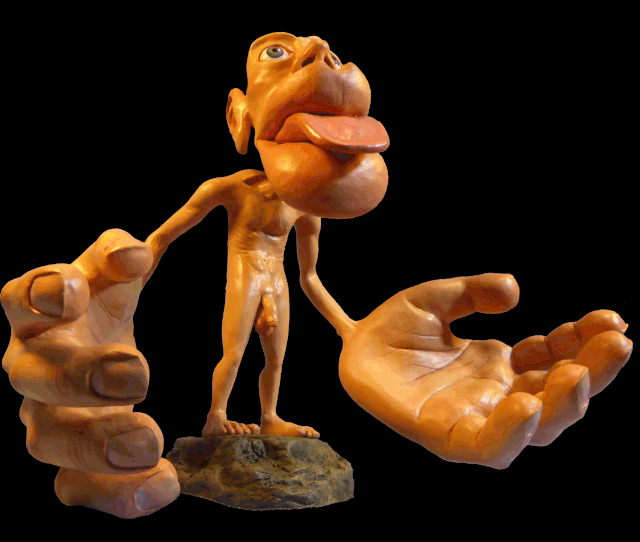
Expected outcomes (what you’ll likely observe)
- Students will likely obtain the result that the greater the opening of the callipers, the more likely the participant will be to correctly identify the “two point” poke.
- This relationship should be clearly observable on the psychometric curve
- Depending on the parts of the body they chose to compare, the distinction between the curves for each part of the body can be quite noticeable, or barely there.
Variations
- The primary variations in this activity will take the form in different number of trials, openings of the callipers, participants, and body parts measured.
- These choices will heavily impact the time commitment for the activity, however, make sure that the number of trials is not reduced too much, or the results may be inconsistent.
Tips and Troubleshooting
- It is possible that, if given the choice to choose which body parts to measure, students may make “unfortunate” choices which really complicate the discussions.
- For example, if a single part is being measured, and students only choose to measure one of low sensitivity, the scope of the discussion promoted by the activity can be quite limited.
- Ensure that you guide students towards choices that are adequate to what you hope to discuss as a class.
- It has also been my experience that using paperclips as makeshift callipers can make this activity much more time consuming, and even a bit frustrating.
- There are alternatives to making the paperclips work better, such as sticking them to popsicle sticks to have better control of the opening during pokes, but those can offer their own challenges.
- I highly recommend ordering cheap plastic callipers online for this activity. You will likely not need too many, only one or two per group of approximately 6-7 students should be fine.
References
- This is a very popular and standard activity in Neuroscience/Psychology classes.
- I am not exactly sure when I was first introduced to it, but I am sure that it is not of my own creation, as the two-point discrimination task is a valuable clinical assessment on its own.
- Nevertheless, I opted to include in this repository both for my own reference, and to provide other educators with a structure to apply their own versions.
Personal Notes
- Personally, I have only run this activity with makeshift callipers using paperclips in the past, and would strongly prefer to purchase proper cheap callipers in the future.
- I think it can be tricky to estimate the time commitment of this activity, since students can vary quite a bit in how long they take to both collect the data, and plot it. If you are working with first years students, for instance, I would recommend overestimating the time commitment for this activity.
- A similar emphasis can be made regarding the plotting of the psychometric functions. Depending on the level of experience your students may have with interpreting and plotting figures, this can be quite a challenge. Be prepared to provide more guidance than you may initially anticipate.